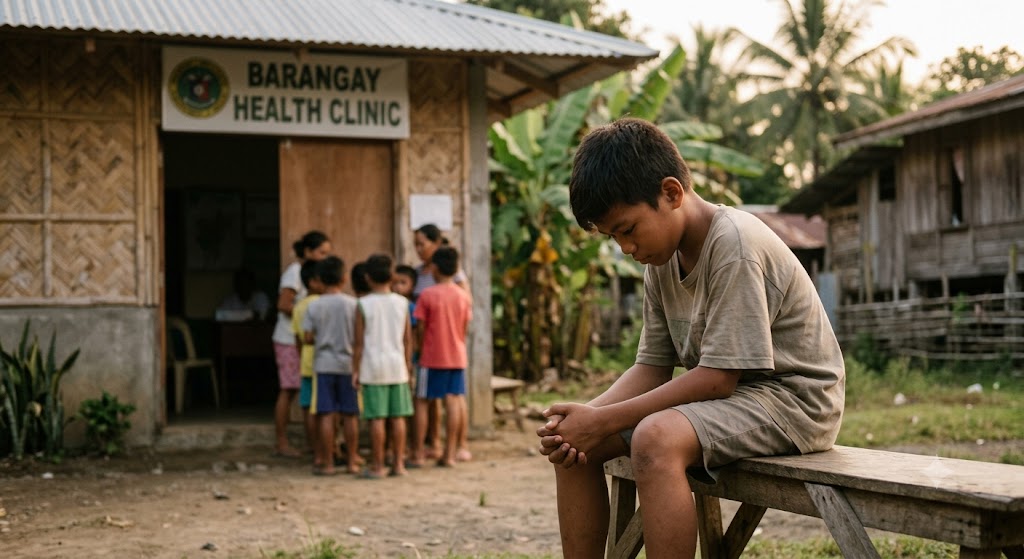
Every summer in the Philippines, thousands of boys line up — at barangay halls, school
gymnasiums, riversides, and clinics — for tuli, the circumcision that Filipino culture treats
as the doorway to manhood. The uncircumcised boy grows up under a word wielded like a weapon:
"supot," a taunt that questions his courage and his belonging. In 2019, psychologist Gregory
Boyle and researcher Samuel Ramos published the first large cohort study to ask a question
the tradition had never been made to answer: what does the experience do to the boys' minds?
A rite older than the republic
Tuli — also called "pukpok" after the tap of the blade — is performed on boys roughly
8 to 16 years old, traditionally by an elderly practitioner known as a manong. In the
classic ritual, the boy's foreskin is positioned over a wooden anvil and a barber's razor
opens a single dorsal slit. It is quick, public, frequently done without anesthesia, and —
in an irony central to this study — comparatively conservative: a slit leaves most of the
foreskin's nerve-dense tissue in place.
Citing tetanus risk from blades and river bathing, the Philippine Department of Health has
long discouraged the traditional form — and the practice has migrated into clinics and mass
"Operation Tuli" events, where physicians typically perform full circumcisions that remove
substantially more tissue than the manong's slit ever did. The scale is industrial: one 2011
event sought a Guinness World Record by circumcising some 1,500 boys in a single day, and
mass drives have been documented on school tables, sometimes with untrained assistants.
Medicalization changed who holds the instrument. This study asked whether it changed
anything for the boy.
What the researchers did
Boyle and Ramos approached 3,253 boys aged 11 to 16 across five schools in Batangas
Province. Crucially, they excluded any boy with prior psychological trauma or pre-existing
PTSD — so what the study measured could not easily be blamed on other wounds. That left
1,577 participants: 505 circumcised in traditional ritual settings and 1,072 circumcised
medically.
Each boy was assessed with the Watson PTSD-I, a standardized interview scale whose
seventeen items map directly onto the DSM-IV's diagnostic criteria — re-experiencing,
avoidance and numbing, physiological arousal, duration beyond a month, functional
impairment — each rated on a seven-point scale. The study was formally registered
(ACTRN12619000589189), ethics-approved through Bond University, and published open access
in Annals of Medicine and Surgery, where anyone can check the methodology.
The numbers
69% of the ritually circumcised boys met the full DSM-IV
criteria for post-traumatic stress disorder. Not passing distress — the clinical
picture: intrusive memories of the day they were cut, avoidance, hypervigilance, impairment
lasting beyond a month. As the authors put it, nearly three of every four boys who went
through traditional tuli were carrying discernible PTSD symptoms.
The number everyone expected to be different was the medical group. It wasn't — not nearly
enough. 51% of the boys circumcised by physicians also met the
PTSD criteria. The ritual setting roughly doubled the odds of trauma (odds ratio
2.13, 95% CI 1.70–2.66, p < .0001) — but the sterile setting still left a
majority of its boys with a diagnosable disorder.
The surrounding data sketches why. Before the procedure, 89.9% of the ritual group and
81.3% of the medical group reported fear and anxiety; most of the rest reported anger.
Asked why they underwent it at all, 56–60% of both groups named social and peer
pressure — the dread of "supot" — with religion second and actual health reasons a distant
third (8.7% ritual, 17.8% medical). These are boys old enough to anticipate, old enough to
be terrified, and old enough to remember.
The comparison that stings
To put the scores in context, the authors compared them against published clinical
benchmarks — and the result is the study's most arresting line: the tuli boys' PTSD levels
were comparable to those of Vietnam-veteran inpatients at a U.S. Veterans Affairs medical
center, and both circumcision groups scored significantly higher than women who had
undergone obstetric procedures they described as "very distressing or terrifying."
A summer rite of passage, measured against war.
Why the clinic doesn't fix it
The standard reform proposal — move tuli from the courtyard to the clinic — rests on the
assumption that the harm is a matter of hygiene and technique. This cohort undercuts that
assumption twice. First, the trauma followed the boys indoors: anesthesia availability and
sterile instruments still left half the medical group meeting PTSD criteria. Second, the
clinical procedure is typically more tissue-destructive than the tradition it
replaced — a full circumcision excises the nerve-dense inner foreskin that the manong's
dorsal slit leaves intact. The authors are blunt about the ethics, invoking the oldest rule
in medicine: primum non nocere — first, do no harm.
The trauma, in other words, does not live in the blade or the venue. It lives in the
experience: a frightened child, pressured by peers and adults, undergoing an irreversible
operation on the most private part of his body — one he did not choose.
The wider stakes
The authors situate the findings in a heavier context. PTSD is an established risk factor
for suicidality, and Filipino males die by suicide at more than twice the rate of Filipino
females. They frame non-consensual genital cutting as a violation of children's rights to
bodily integrity and self-determination, citing UNESCO's 2005 bioethics principles — and
they note, pointedly, that the Catholic Church itself has denounced non-therapeutic
child circumcision, in a country where the rite is often justified as religious tradition.
What the study can't tell us
The authors flag their own limits, and so do we. There was no control group of intact
boys, so the baseline rate of PTSD-scale symptoms in this population is unknown. The two
groups differed in size, which can inflate statistical significance. Nobody yet knows how
these symptom rates evolve as the boys age, and the findings need replication in other
Philippine regions. This is one retrospective cohort built on structured self-report —
strong enough to take seriously, not the last word.
Why it matters beyond the Philippines
Most circumcision debates founder on a missing witness: the infant who cannot say what it
was like. Tuli's cruelty as a research subject is its honesty — the boys are old enough to
remember, and when 1,577 of them were finally asked, a majority described the textbook
anatomy of trauma. The lesson travels. Wherever a culture cuts boys to make them men —
and whoever it hires to hold the instrument — this study suggests the cost is paid in the
same currency. The variable that matters is not the venue. It is the consent.