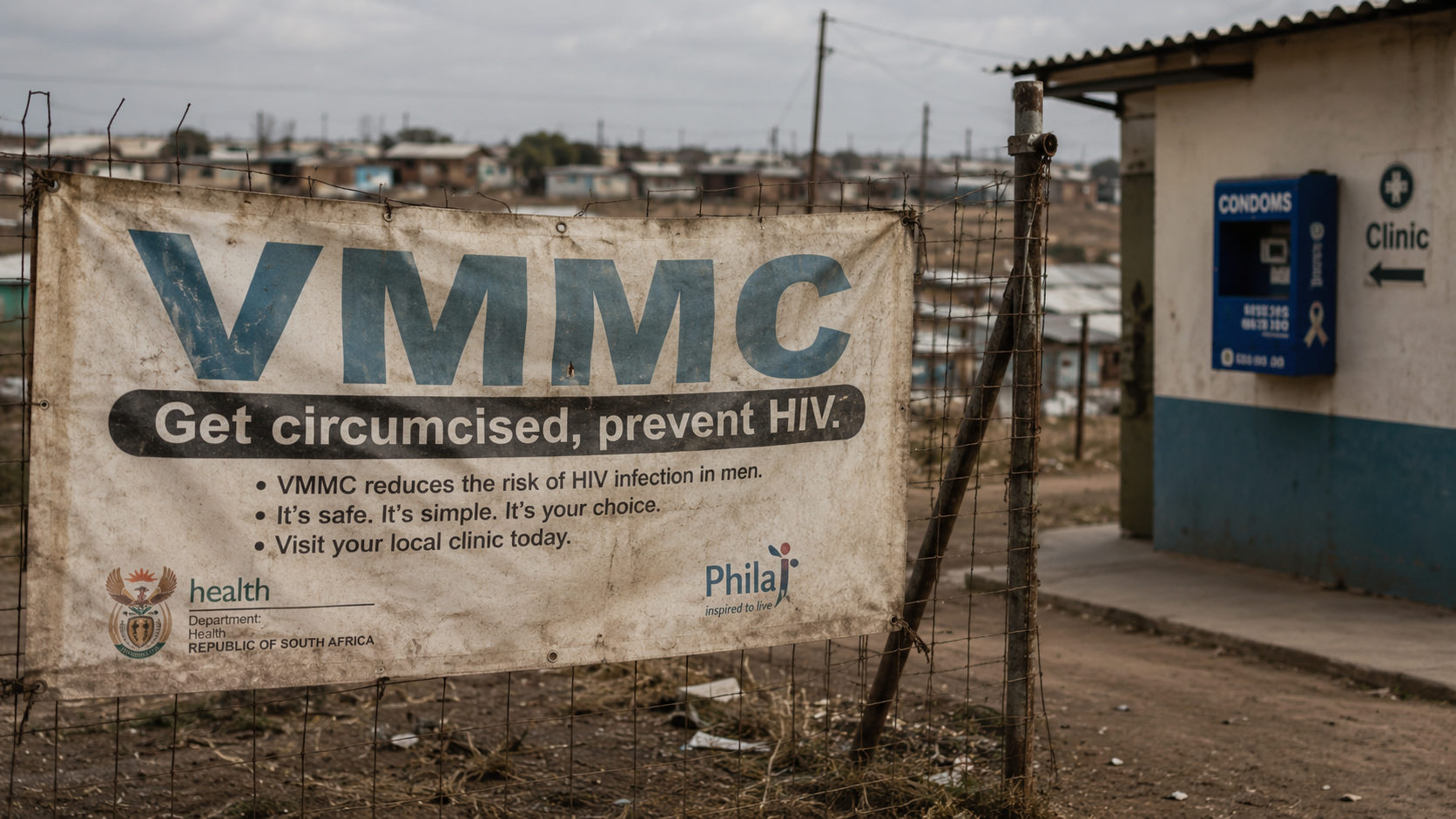
The single most powerful argument for circumcising healthy boys is a number: the randomized
trials in Orange Farm, Kisumu, and Rakai reported that adult male circumcision cut female-to-male
HIV transmission by roughly 60%. From that finding grew a continent-wide campaign — voluntary
medical male circumcision, or VMMC — and a talking point that now travels far beyond Africa:
circumcision prevents disease, so the trade-off is worth it. It is worth looking closely at that
number, because the people who cite it most rarely mention what it leaves out.
The claim, stated fairly
We will not pretend the biology is nothing. Reviews by circumcision's strongest advocates
compile real associations: lower rates of HIV during heterosexual intercourse, and reduced risk
of some other infections — high-risk HPV, HSV-2, syphilis. We catalogue those papers in our
reference library, including the other side's most thorough version of the argument, so the case
can be engaged at its strongest rather than a strawman. The question is not whether circumcision
does anything. It is whether that something justifies cutting a child — and whether the
prevention math is even complete.
The variable the trials forgot
It is not. In 2007, writing in PLoS Medicine, Kalichman, Eaton and Pinkerton named the
hole in the model: risk compensation. When people believe a
technology has made them safer, a predictable share of them take more risk to match — fewer
condoms, more partners, earlier sexual debut. The circumcision trials, conducted under intensive
counselling and free condom supply, never fully accounted for what happens when that protective
belief meets the real world without the counsellors.
The consequence is an irony the campaigns do not advertise. A condom blocks essentially every
sexually transmitted infection and protects both partners. Circumcision blocks some infections,
partially, in one direction. If the belief in circumcision's protection nudges a man away from the
condom, the math can invert: he is now more exposed to the gonorrhea, chlamydia and
other infections the condom would have stopped — and so is she. A partial, one-directional shield
purchased at the cost of the complete, two-directional one is not obviously a bargain.
What the evidence actually shows
Here honesty cuts both ways, and we will be honest. The evidence on whether risk compensation
actually materializes is mixed. Some cohorts — including post-trial follow-up in South
Africa — found circumcised men did not reduce condom use. A Cape Town study even found that men
who had heard circumcision was protective used condoms slightly more, not less. Other work, in
Kenya and elsewhere, found exactly the compensation Kalichman warned about. The truthful summary
is not "circumcision increases STIs." It is narrower and harder for the other side to dismiss:
the protective claim is incomplete, the real-world effect is
unsettled, and a confident "it prevents disease" oversells a contested, partial, condom-inferior
benefit.
The deeper blind spot
Step back and a pattern appears in how these arguments are built. Researchers optimize a single
variable — a virus, in a population — and report the number that variable produces. What rarely
enters the model is the human being downstream of it: the man whose reduced sensation may change
how he uses protection, the second-order behavior, the psychological weight of having been
permanently altered as an infant for a statistical edge he never chose. A circumcision that
lowers one risk while raising another, and removes healthy tissue from someone who could not
agree, is not the clean win a single hazard ratio makes it look like.
Why it doesn't matter as much as they think
And here is the part that makes the whole STI debate, for us, beside the point. Suppose the
prevention figures were airtight and risk compensation never happened. The case for infant
circumcision would still fail, because adults who want the protection can choose it for
themselves, with consent, as adults — and a child cannot. We don't remove healthy appendices or
breast tissue from infants to lower their lifetime cancer odds, even though it would. Bodily
autonomy is not a number to be outweighed by a better number. It is the thing the numbers were
never entitled to decide.