
A global history of circumcision
Circumcision is one of humanity's oldest and most widespread body modifications — and its justifications have shifted dramatically across the millennia: from ritual sacrifice, to covenant, to Victorian medicine, to a modern reckoning over a child's right to an intact body.
A timeline across the world
15 milestones across five eras · every claim sourced to the references library.
Ancient World
Ritual, hierarchy, and the oldest scars in the archaeological record
Rites of passage
Long before writing, several unrelated peoples independently cut the foreskin as a rite of passage from boyhood to manhood. The exact origin is unknown and unknowable — circumcision appears to have arisen separately in multiple regions rather than spreading from a single source. [1]

The oldest pictures
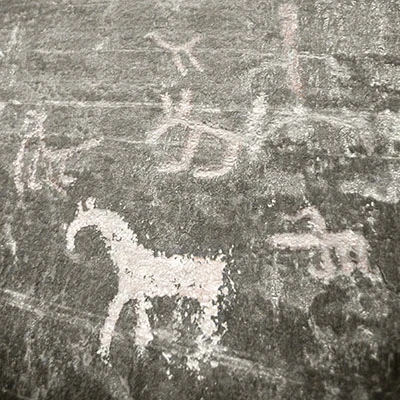
The earliest surviving depictions of the operation are Old Kingdom reliefs at Saqqara — a fragment from the pyramid complex of King Djedkare, and the famous scene in the tomb of the vizier Ankhmahor (the "Tomb of the Physician," c. 2345 BCE). They show a real surgical act, though the practice's true origin is older and unknowable. [2]
Covenant & Faith
How circumcision became a marker of religious identity — and why Christianity dropped it
Paul: faith, not flesh
Early Christianity decisively rejects circumcision as a requirement. In Galatians, Paul argues that faith — not cutting — defines the believer, severing the new religion from the practice and shaping a largely intact Christian Europe for two millennia. [5]
Khitan
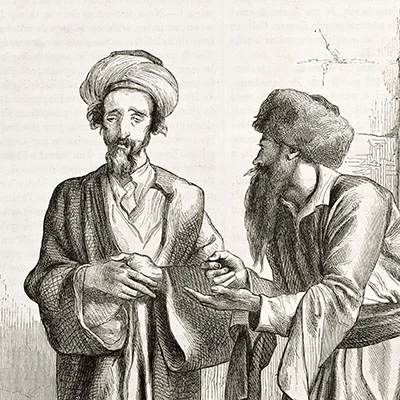
Circumcision (khitan) becomes a widespread custom across the Islamic world. Though not mentioned in the Qur'an, it is practiced as a tradition of cleanliness and identity, performed at varying ages by region — today the largest share of the world's circumcised men are Muslim.

Maimonides on pleasure
In the Guide for the Perplexed, the rabbi and philosopher Moses Maimonides writes that a purpose of circumcision is "to bring about a decrease in sexual intercourse and a weakening of the organ" — a candid admission of reduced sensation that modern medical promoters often deny. [6]
The Victorian Turn
How English-speaking medicine reinvented an ancient rite as a 'cure'

The masturbation 'cure'
Victorian doctors in the English-speaking world begin promoting circumcision as a remedy for masturbation — then believed to cause disease and insanity. The same era saw girls subjected to clitoridectomy for the same supposed reasons. [7][8]

Medical rationalization
As the masturbation theory faded, new justifications appeared — preventing infection, "phimosis" (a tight foreskin, normal in young boys), and "hygiene." Despite scant evidence, circumcision became fashionable, helped along by a fee-for-service medical system that paid for the procedure. [9]
The American Century
How one country made a minority practice feel 'normal' — and exported it
An American custom
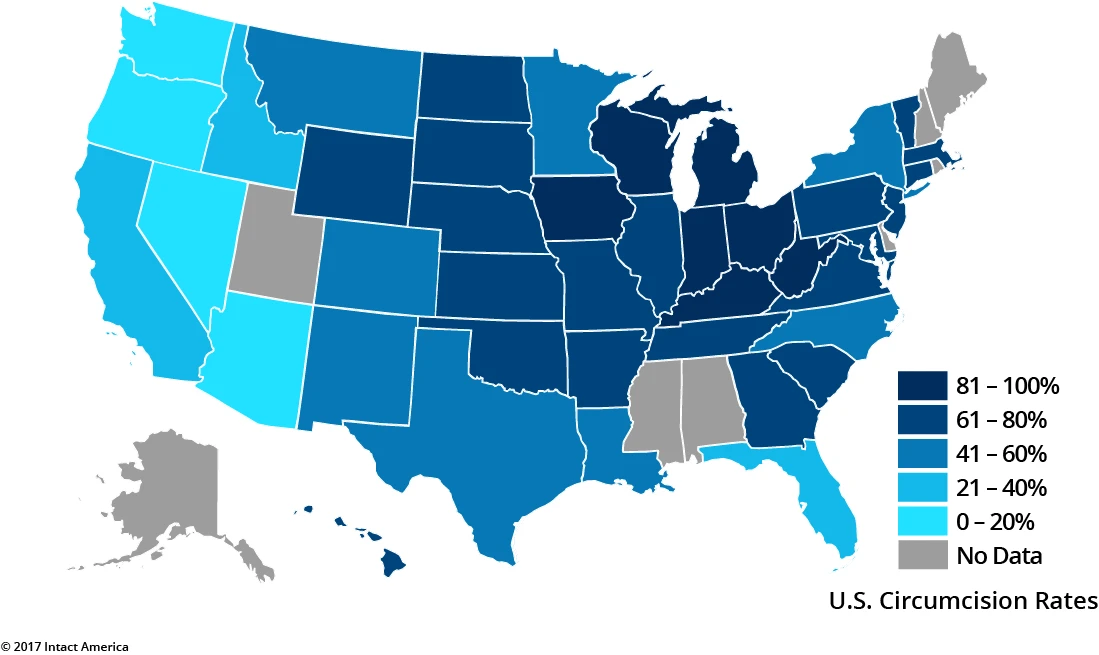
Routine newborn circumcision becomes the norm in the U.S. while Britain, Canada, Australia, and New Zealand abandon it. The national newborn rate peaked at 64.9% in 1981 (CDC data) — higher in some regions (the Midwest reached ~83%) — making the cut feel "normal" to Americans even as most of the world's men remained intact. [10]
Exported by influence
American cultural and military influence spread circumcision abroad. In the Philippines it became near-universal peer-pressured "tuli," despite the country being Christian and Spanish-colonized (Spain is ~94% intact). South Korea, almost entirely intact before the Korean War, adopted it rapidly under U.S. presence. [54]

Medicine reverses course
After decades of decline, the American Academy of Pediatrics concludes in 1999 that the evidence is "not sufficient to recommend routine neonatal circumcision," leaving the choice to parents. Britain's NHS had already stopped funding it as non-essential back in 1949. [29]
The Turning Tide
A global reckoning over children's bodily autonomy
Girls protected — boys not
The U.S. Federal Prohibition of Female Genital Mutilation Act makes any genital cutting of girls under 18 a federal crime. The result is a stark legal asymmetry: girls are fully protected from non-consensual genital surgery while boys remain unprotected.
A court calls it harm
On 26 June 2012 the Cologne regional court rules that non-therapeutic circumcision of a boy is criminal bodily harm — a child's right to bodily integrity outweighing parental and religious claims. The same year the AAP states benefits "outweigh the risks"; in 2013, 38 physicians publish a formal rebuttal in Pediatrics calling that conclusion culturally biased. [30]
Northern Europe pushes back
Children's ombudsmen across Denmark, Sweden, Norway, Finland, and Iceland jointly oppose non-consensual circumcision of boys. In 2018 Iceland debates a bill to ban it outright — the first European country to propose criminalizing it.
A generation questions
The U.S. newborn rate falls to 49.3% by 2022 (down from 54% in 2012) — for the first time, most American baby boys are left intact. A global, internet-connected generation questions the practice, intactivist organizations grow, early-stage foreskin-regeneration research advances, and the framing shifts from "hygiene" to bodily autonomy. [11]
Is it really about religion?
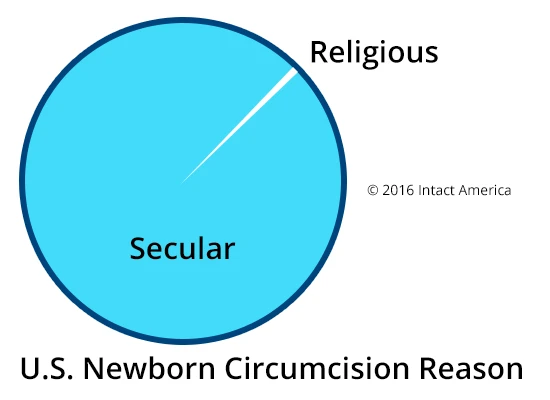
It's the assumption almost everyone makes — and it's wrong. In the United States, religious circumcision is vanishingly rare.
Fewer than one percent of American newborn circumcisions are religious rites [12]. The other ninety-nine percent happen in hospitals, by doctors, with no spiritual meaning at all — a medical habit wearing a cultural costume.
Freedom of religion is the right to choose your own beliefs. Permanently altering a newborn's body in the name of a faith he can't yet hold takes that choice away.
U.S. newborn circumcision, by stated reason
An American custom, not a world norm
Step outside the United States and the picture flips. Most of the world's circumcised men were cut for religion or culture — in the Muslim world, Israel, and parts of Africa — not by a doctor at birth. Routine newborn circumcision for non-religious reasons is overwhelmingly an American story, exported through US influence to a few places like the Philippines and South Korea.
A large majority of the world's non-religious newborn circumcisions take place in the United States. [12]
Keep exploring
See how today's rates and laws compare across the world.